Connectivity Technology Products & Services
Lumen Wavelength Services
〰️
Spectrum Business Internet
〰️
Verizon Internet Dedicated Services
〰️
AT&T Business Fiber
〰️
Comcast Business Managed Connectivity
〰️
Lumen Wavelength Services 〰️ Spectrum Business Internet 〰️ Verizon Internet Dedicated Services 〰️ AT&T Business Fiber 〰️ Comcast Business Managed Connectivity 〰️
Obtain competitive rates typically paid by large organizations, with the most favorable terms and conditions available.
Estimates in 1 Hour - Agnostic to Provider - based on your redisence or business address
High-speed internet (typically defined as broadband with at least 100 Mbps download speeds, per updated FCC standards) pricing trends in the US show a mix of long-term declines in real terms (adjusted for inflation) for popular plans, alongside some recent increases in average advertised prices due to shifts toward ultra-fast multi-gigabit offerings.
Current Average Costs (Mid-2025 to Early 2026)
Typical household bills (including fees/taxes, post-promo): Often $70–$90/month for common high-speed plans. Standalone advertised averages hover around $78–$85/month across providers.
By connection type (approximate advertised or effective averages):
Cable: ~$59–$95/month (mid-tier plans frequently $50–$80 after promos, with post-promo increases common).
Fiber: ~$80–$120/month (entry 300–500 Mbps often $50–$90; gigabit ~$70–$100; multi-gig higher).
5G Home / Fixed Wireless: ~$50–$75/month (frequently $35–$60 with mobile bundles; very competitive and transparent pricing).
DSL: ~$60/month (slower, declining relevance).
Satellite: ~$120+/month (higher for remote areas, with data considerations).
Multi-gig (2 Gbps+): $100–$300/month, averaging ~$150–$180 for 2 Gbps plans. These remain premium but are becoming more available in fiber markets.
Price-per-Mbps continues to improve significantly, especially on fiber and competitive cable/wireless offerings.
Prices vary widely by location, provider (AT&T Fiber, Verizon Fios, Xfinity, Google Fiber, T-Mobile/Verizon 5G Home, Frontier), competition level, promotions, and bundles. Urban/suburban areas with multiple options often see lower effective rates. Many providers now emphasize price locks (no annual increases for 1–5 years) to reduce "bill shock." Low-income subsidies (e.g., via ACP successors or provider programs) and bundles can lower costs further.
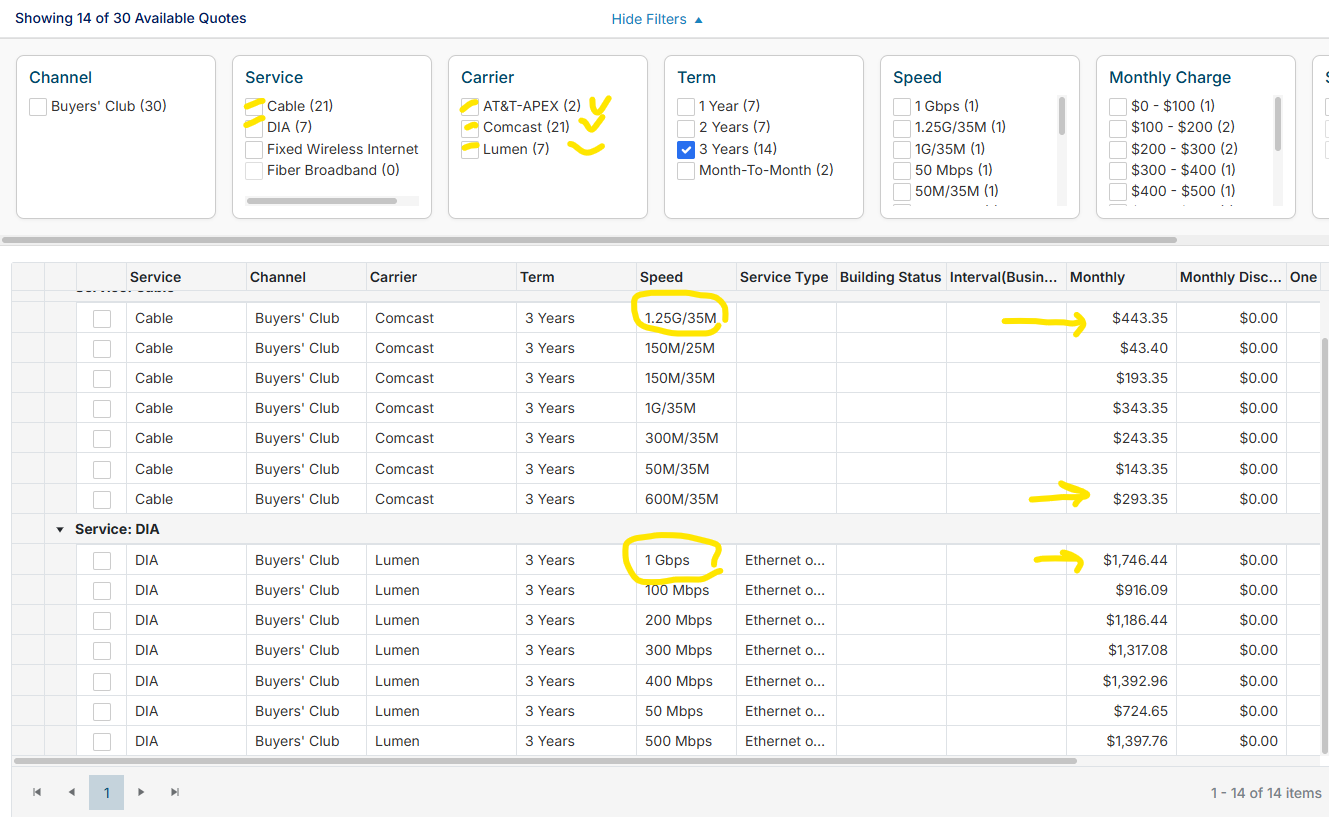
TYPICAL DIA CONNECTIVITY PRICING NATIONWIDE (March 2026)
Typical monthly recurring costs for Dedicated Internet Access (DIA) at 1 Gbps and 2 Gbps in the US (as of early 2026) are substantially higher than standard business fiber or residential plans. DIA delivers a fully dedicated, uncontended symmetric fiber connection with guaranteed bandwidth (Committed Information Rate/CIR), strict SLAs (often 99.99% uptime), low latency/jitter, priority 24/7 support, and features like static IPs or managed security. It suits mission-critical operations, large data transfers, cloud workloads, or environments intolerant of congestion.
1 Gbps DIA
• Typical range: $700 – $1,500/month (on-net metro lows around $600–$900; higher in less competitive areas or near-net).
• Provider examples (on-net):
• Lumen: $700 – $800
• Zayo: $600 – $800
• Verizon: $900 – $1,000
• Spectrum/Comcast: $800 – $1,000
• AT&T: $1,000 – $1,400
• Broader market median (recent analyses): ~$900
2 Gbps DIA
• Typical range: $1,000 – $2,500+/month (often scales from 1G quotes; not always a fixed advertised tier—frequently custom between 1G and higher).
• Provider examples: Generally 1.2–1.8x the 1G price in the same market (e.g., $1,200–$2,000 for many carriers on-net). Exact quotes require provider input as 2G falls in the multi-gig transition band.